

One parent starts a book with the kids. A few days later, the other parent has a chance to read, but nobody remembers exactly where they stopped. Someone finds the page, someone else tries to explain the plot, and by the time everyone is caught up, the moment has passed. The book goes back on the shelf.
If your family homeschools around work shifts, appointments, and everything else that fills a week, this may sound familiar. A shared book can feel like one more thing that needs a perfectly consistent schedule. It doesn’t. You only need a way for the next reader to pick up where the last one left off.
Here is a simple family read aloud routine you can use with a library book, a book you already own, or even an audiobook: read, leave a note, pass it on.
Start with a book your family actually wants to return to
You don’t need to choose a book because it appears on a curriculum list. Ask what your children are curious about right now. A funny picture book, a chapter book with short sections, or a nonfiction book about animals can all work. If one book doesn’t hold everyone’s attention, try another. The point is to make it easy to come back.
Keep the book where the next adult can find it. If you’re listening to an audiobook, write down the title, chapter, and time stamp in the same place you keep your note. That small detail saves the next person from hunting through a listening app while the kids wait.
Read when the opportunity is there
A homeschool read aloud can happen over breakfast, after a work shift, while a toddler plays nearby, in the car with an audiobook, or before bed. There is no special hour that makes the reading count more. Five or ten engaged minutes are useful, and you can stop at a natural pause even if the chapter isn’t finished.
If several children are listening, don’t expect everyone to sit perfectly still. Some children listen better while drawing or building. You can pause for a question, but you don’t have to turn every page into a lesson. Let the story be enjoyable, too.
When your time is up, tell the kids where you are stopping. Then make the handoff before the details disappear from your own mind.
Leave a note the next reader can use in seconds
The note does not need to summarize every event. Three details are usually enough:
- Where to begin: the next page, chapter, or audiobook time stamp.
- What just happened: one sentence that gives the next reader their bearings.
- What the child noticed: a question, prediction, favorite moment, or new word.
For example, a handoff note for an imaginary story could say:
Start next time: Page 25. What happened: Maya found a map inside an old coat and decided to follow it. Child’s question: “Why would someone hide a map there?” Ask what the first clue might lead to.
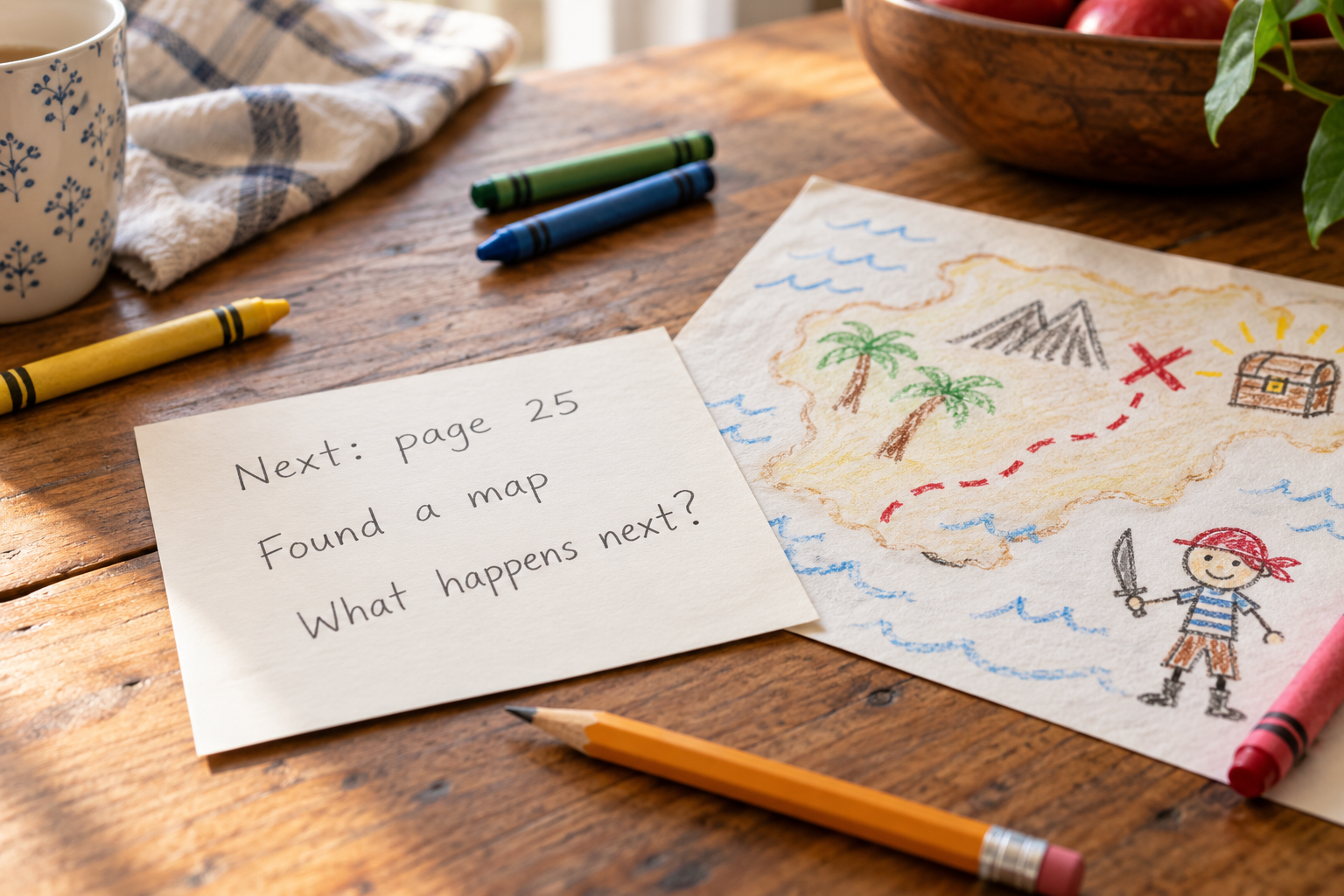
That’s enough context for another adult to open the book and begin. It also tells them what mattered to the child, which is often more useful than a detailed plot recap. If you’re the only adult reading most of the time, the note still helps you return after a busy few days.
Put the note in the book, on a bookmark, or in a folder near your reading spot. For an audiobook, keep it in a shared note on your phone. Use whichever place both adults will actually check.
Pass the story on without starting over
The next reader can glance at the note, ask the child what they remember, and continue. If your child wants to retell the whole story, enjoy it when you have time. If you have only a few minutes, try: “I see you wondered about the map. What do you think we’ll learn today?”
It is okay if one adult reads more often than the other, or if a week passes between sessions. This isn’t a relay with a deadline. The handoff simply makes it easier to return whenever someone is available.
You can give children a role in passing the story on, too. One child might place the bookmark. Another might choose the question to leave for the next reader. The routine becomes something the family shares instead of another task one parent has to manage alone.
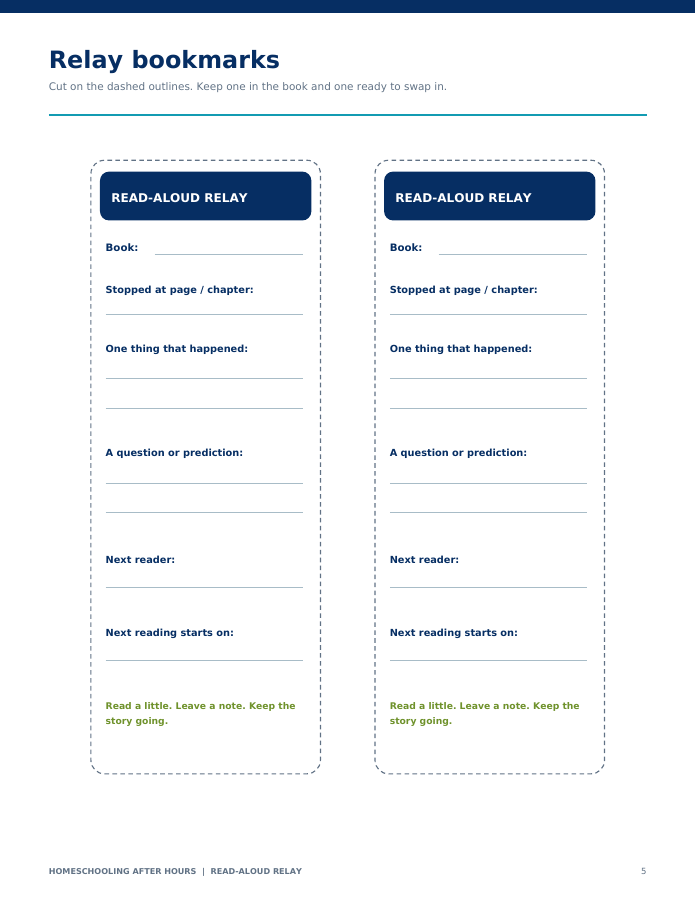
A bookmark to pass the story along
The kit’s relay bookmarks give the next reader a place to start and a small reminder to leave a story note. Here’s a peek at the printable bookmark page:
Five questions that work with almost any book
You don’t need a worksheet after every reading session. Pick one question when a conversation feels natural. These work with many picture books, chapter books, and nonfiction titles:
- What is one thing you noticed that we should remember next time?
- What do you think might happen next? What makes you think that?
- Was there a part that surprised you or changed your mind?
- What would you ask a character, the author, or the person in the book?
- What is one new thing you learned, or one word you want to explore?
There is no need to ask all five. A brief answer can lead to a wonderful conversation, and some days your child may just want to keep listening. You can always jot down their question and revisit it later.
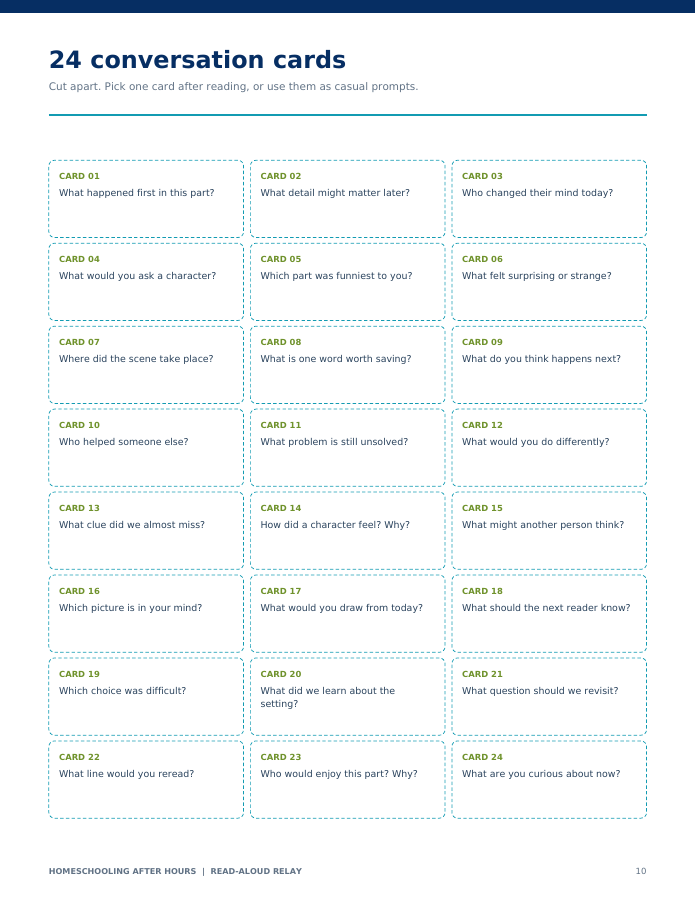
More questions when you want them
If your family enjoys choosing a question from a card, the kit has 24 cut-apart conversation prompts you can use with many different books:
Let each child respond in a way that fits
For a younger child, a response might be a drawing of a character or a favorite scene. They can point, act something out, or dictate one sentence while an adult writes it down. A child who is beginning to write might label a picture or copy a new word from the book.
Older children can write a prediction, collect unfamiliar words, compare two characters, or leave their own handoff note. They might also enjoy seeing whether their earlier prediction changed as the story developed. None of these responses has to happen every time.
When multiple ages listen together, give everyone the same open-ended question and let them answer differently. That keeps a shared story from becoming three separate assignments. If the book is above a younger child’s reading level, they can still join the conversation through what they heard and noticed.
Keep the system small enough to use again
The best read aloud for busy families is one that survives an ordinary week. A book and a scrap of paper may be all you need. If a reading log adds pressure, skip it. If your kids love seeing completed books listed in one place, keep one. Adapt the routine instead of abandoning it when a week changes.
Try the three-step handoff with your next book: read a little, record where you stopped and one child comment, then leave the book ready for whoever reads next. You can build from there once you know what helps your family.
If you’d like those pieces together, the Read-Aloud Relay Kit ($4.49) is a printable option with a handoff sheet, two bookmarks, 24 conversation cards, activity pages, and a completed-books log. You can use the pages that fit your family and leave the rest for another book.
Your schedule doesn’t have to look the same each day for a story to belong to everyone. Begin with a book your kids want to hear, leave a note for the next reader, and let the story travel with your family. If a ready-to-print version would make that easier, you can see the Read-Aloud Relay Kit here.