When children hear the word “voting,” they may picture two people running for president. That is an understandable starting point, but it leaves out so much of what voting is for.
Voting is a way for a group to make a decision using an agreed process. Children can begin exploring that idea long before they are old enough to vote in a government election. Choosing a classroom celebration, considering a community project, or deciding on a club activity gives them a concrete place to practice.
For working parents, this can be a short conversation at breakfast, during a weekend learning block, or after a shift. You do not need a long government unit to help your child understand that choices, evidence, and other people’s voices matter.
Get the free Election Day Civics Lab to try a fictional community vote together.
Voting is about more than electing a president
In the United States, voters choose people for many different jobs. Depending on the election and where they live, those choices may include members of Congress, state officials, mayors, school board members, or other local representatives. Some ballots also ask voters to decide proposed laws or policies, called ballot measures. USAGov explains state and local elections here.
A child-friendly explanation might be: “Sometimes we vote for a person to do a job. Sometimes we vote on a question. In both cases, we need to understand what we are choosing.”
A community may be considering a project or a funding proposal. A classroom might choose an end-of-unit celebration. A club could select a service project. These decisions differ in their importance and in the rules they follow, but they create opportunities to practice learning about options, explaining reasons, and counting choices fairly.
Teach the shared principles, then explain the different rules
The basic habits carry over: make the question clear, explain who can participate, agree on the decision rule, give people a chance to consider the choices, and count accurately.
The exact rules are not identical everywhere. A classroom vote is a simplified activity. Government elections follow laws about eligibility, ballots, deadlines, and counting. The U.S. presidential election also uses the Electoral College rather than a single nationwide popular-vote tally. Start with a simple model and let children know that more detailed systems exist.
Before a practice vote, ask: “What happens if two choices tie?” and “Does the winner need the most votes, or more than half?” Agreeing beforehand helps children understand that a fair process should not change just because someone dislikes the result.
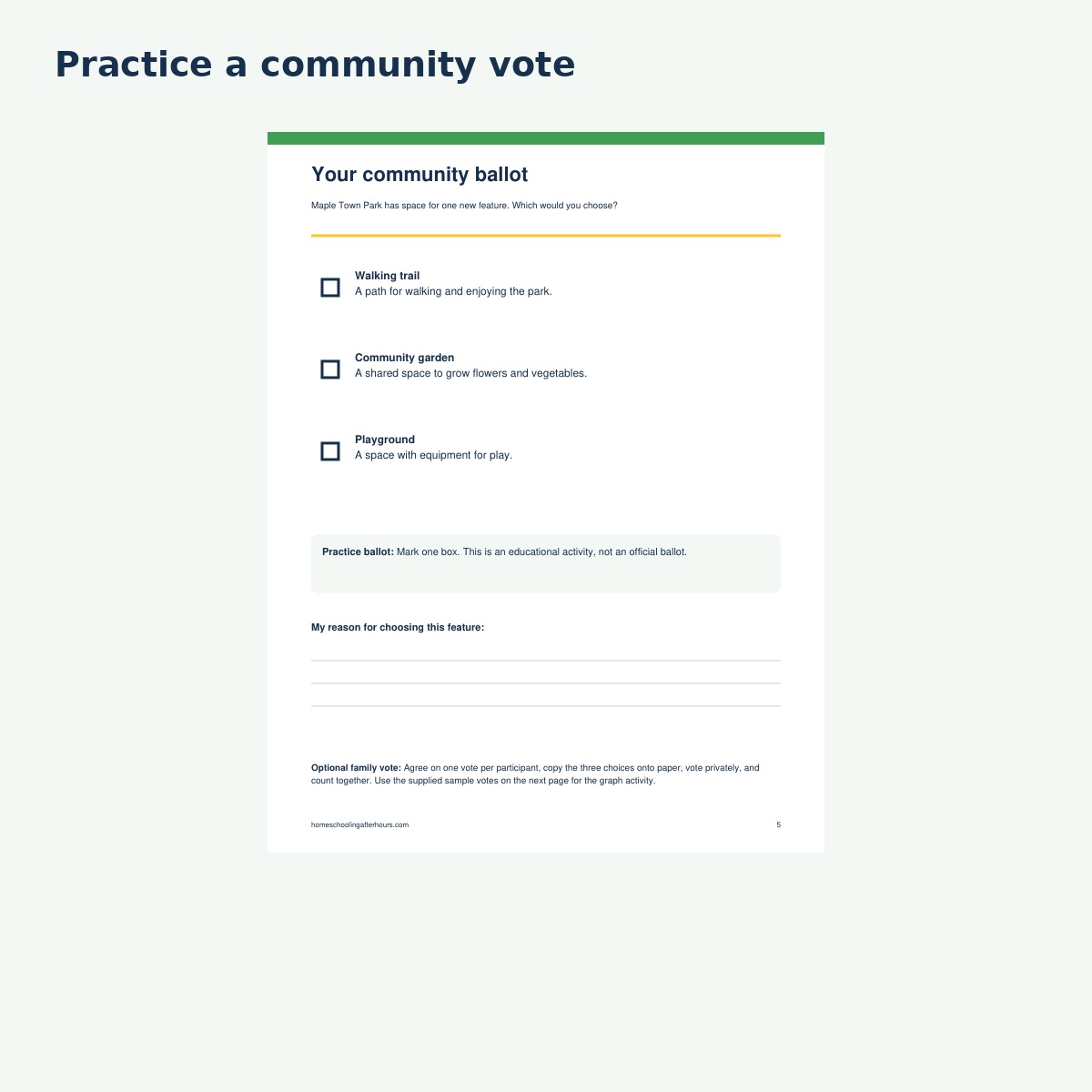
Try a park project vote at your table
Imagine a town has space for one new park feature: a walking trail, a community garden, or a playground. Ask each child to think about who might use each option and what questions the town should answer before making a decision.
Perhaps a child prefers a playground because they like climbing. Someone else might want a trail that different generations could enjoy. The point is not to steer everyone toward the same answer. It is to help them connect a choice to a reason.
- Name the decision. Choose one park feature from three options.
- Set the rules. Give each participant one vote. Decide how to handle a tie.
- Discuss the options. Invite a reason from everyone without pressuring them to change their vote.
- Cast and count. Use simple paper ballots and count together.
- Reflect. What did the results tell us? What did they not tell us?
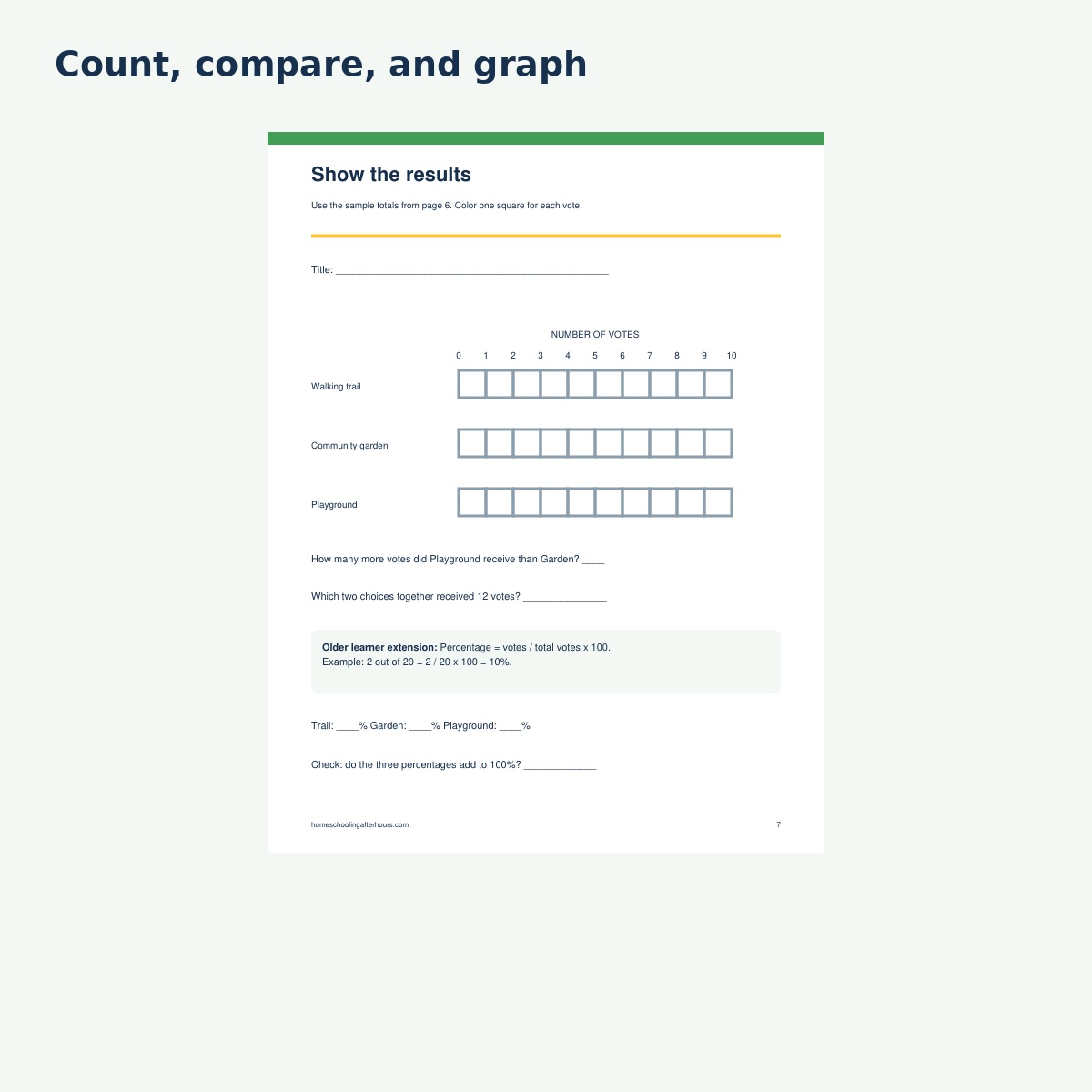
If you only have a few participants, use the twenty fictional votes in the free printable for the counting and graphing activities. Your family’s vote can be a separate conversation.
The most votes and a majority are different
This is a useful math lesson hiding inside a civics activity. In our fictional sample, the trail receives seven votes, the garden receives five, and the playground receives eight. There are twenty votes altogether.
The playground has more votes than either other choice. That is a plurality. It does not have a majority, because a majority means more than half. With twenty votes, a choice would need at least eleven for a majority.
Under a rule that awards the decision to the choice with the most votes, the playground wins. Under a rule requiring a majority, another step would be needed. That is why stating the rule before voting matters.
Make room for listening and disappointment
A child can understand the count and still feel disappointed. Try: “You hoped the garden would win. Tell me what you liked about that idea.” Then ask how the group can treat people whose choice did not win.
Children can practice disagreeing without calling someone foolish, listening without interrupting, and explaining a preference without assuming everyone shares it. Voting does not mean the people in the minority stop mattering, and it does not settle every question about what is fair.
Adults also need to set appropriate limits. A group vote should not decide whether one child deserves kindness, access, or inclusion. Choose genuine, suitable options rather than turning someone’s needs into a popularity contest.
Bring language arts and information skills into the lesson
Ask children to finish the sentence “I choose this because…” Younger learners can draw their preferred feature or dictate a reason. Older learners can write a short explanation, compare two options, or describe information they would want before making a real decision.
Help them distinguish facts, opinions, and predictions. “The sample has twenty votes” can be checked. “Playgrounds are the most fun” is a preference. “More people will visit next summer” is a prediction that has not yet been established.
Useful questions include: Who made this statement? What evidence supports it? When was it published? Where can we check the original information? These habits are helpful beyond election season, including when children read advertisements, compare products, or consider proposals in a group.
Explain why real results can take time
A practice ballot count may take a few minutes. Real elections involve many more ballots and required checks. The U.S. Election Assistance Commission explains that results are unofficial until they are certified. Read its explanation of counting, reviewing, and certifying results.
If you look at a real election with your child, use an official state or local election source and notice whether it labels results unofficial or certified. That gives you another practical lesson: a first report and a final result are not always the same thing.
Get the free Election Day Civics Lab
Our ten-page printable brings the conversation together with vocabulary matching, election-process sequencing, a fictional park ballot, sample votes, tallying, graphing, optional percentages, fact-versus-opinion practice, and an observation page. An answer key and flexible-use suggestions are included.
Use one activity at a time, whenever your schedule allows. Read aloud, draw, dictate, or write. You can use the kit during election season or any time your family wants to explore how groups make decisions.
Get my free Election Day Civics Lab
Teaching kids about voting can begin with one small decision and a few thoughtful questions. Help them understand the choices, listen to other people, and pay attention to how the decision is made.